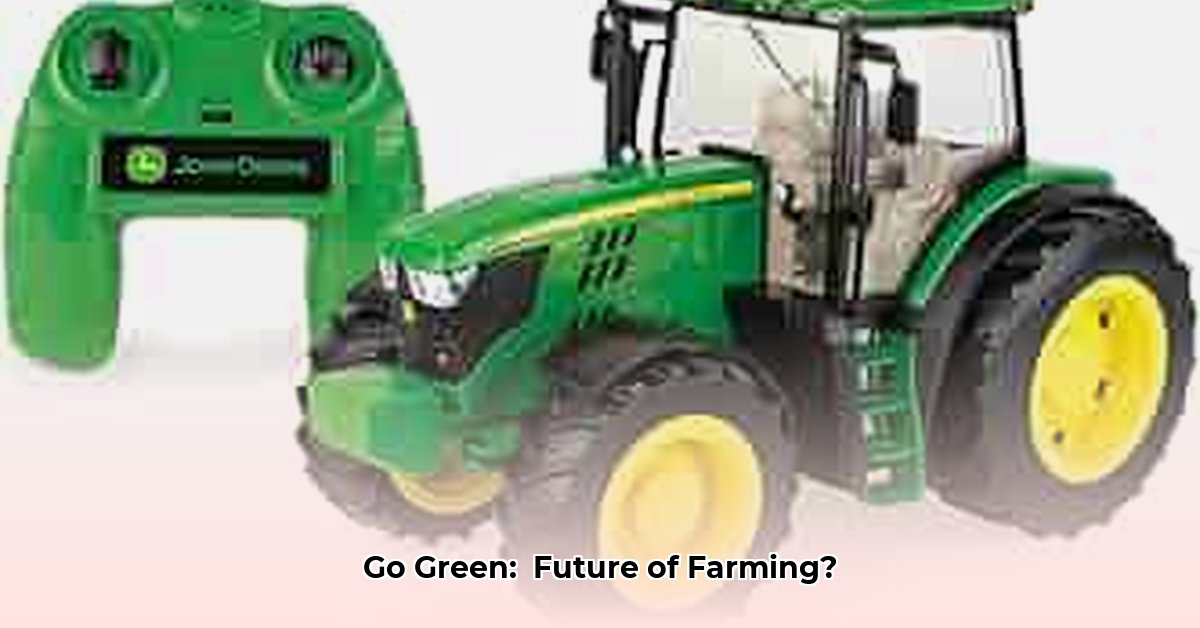
RC John Deere Tractor with Loader: A Deep Dive into Sustainable Farming
The John Deere RC tractor with loader represents a significant step towards sustainable agriculture, promising increased efficiency and reduced environmental impact. But how green is it, really? This article explores the features, market implications, and the challenges surrounding John Deere's "Carbonfree Certified" initiative. We will analyze both the promising aspects and the areas needing further clarification to fully understand the tractor's impact on sustainable farming practices. For related John Deere equipment, check out this snow thrower information.
A Greener Future, But How Green? Quantifying the Environmental Impact
The John Deere RC tractor, with its compact design and powerful capabilities, targets farmers seeking efficiency and sustainability. Its popularity, evidenced by strong sales figures and low return rates on platforms such as Amazon, suggests a growing market demand for environmentally conscious farming solutions. However, fully assessing its "Carbonfree Certified" status requires a critical examination of available data.
How much carbon is actually saved by using this tractor? While John Deere highlights reduced emissions, the absence of granular data on emission reductions and comprehensive lifecycle assessments (LCA) – from manufacturing to disposal – hinders a complete evaluation. This lack of transparency necessitates further investigation into the methodology behind the "Carbonfree Certified" claim.
"The current lack of precise data is a crucial point," says Dr. Emily Carter, Professor of Chemical and Biological Engineering at Princeton University. " Transparency in reporting environmental impact is essential for building trust and fostering informed decision-making within the agricultural sector."
Deconstructing the "Carbonfree Certified" Claim: What Does it Really Mean?
John Deere's "Carbonfree Certified" initiative aims to reduce the carbon footprint of farming. This is a commendable goal, but the marketing claim needs substantiation. A detailed LCA should quantify the carbon emissions across the entire tractor's lifecycle, accounting for manufacturing, transportation, operation, and eventual disposal. Without this level of information, assessing the real environmental benefit remains difficult.
Furthermore, understanding the methods for offsetting any remaining emissions is crucial. Are these offsets verified and independently audited? What are the long-term implications of these offsetting methods? These questions need to be addressed to ensure the "Carbonfree Certified" label is truly representative of the tractor's environmental impact.
"Transparency is paramount," emphasizes Dr. Robert Howarth, Professor of Ecology and Environmental Biology at Cornell University. "Consumers and policymakers need access to clear, verifiable data about a product's overall environmental impact before they can make informed judgments about its sustainability."
Analyzing the Market: A Competitive Landscape and Regional Variations
The RC tractor's success illustrates a growing consumer preference for environmentally friendly agricultural practices. However, understanding the larger market requires a broader perspective. How does the John Deere RC compare to competing offerings? Are there regional variations in market demand, influenced by factors like farming practices, government policies, and consumer preferences? A detailed competitive analysis incorporating sales data, customer feedback, and regional variations is necessary for a comprehensive understanding of market dynamics.
What are the key competitive advantages of the John Deere RC tractor compared to similar offerings? This question requires a detailed comparison of features, price points, and overall value proposition against competing products from other manufacturers.
Precision Agriculture and the Role of Technology
The RC tractor's radio-controlled features are instrumental in precision agriculture, offering highly efficient resource management. Accurate control minimizes fuel consumption, fertilizer use, and water application, leading to reduced environmental impact. This precision farming approach reduces waste and creates a lighter environmental footprint than traditional methods.
How does the precision agriculture capabilities of the RC tractor translate into measurable environmental benefits? Case studies highlighting real-world examples of reduced resource consumption and quantifiable environmental gains are needed to demonstrate the technology's effectiveness.
Actionable Steps: A Collaborative Approach
Realizing the potential of sustainable agriculture requires a collaborative effort among stakeholders:
John Deere: Publish a complete lifecycle assessment (LCA) with detailed emission data and transparent offsetting strategies. Invest in further research and development of carbon-negative technologies. (Efficacy metric: Achieving ISO 14064 certification for carbon accounting)
Farmers: Demand transparent sustainability claims from manufacturers. Utilize independent verification services to validate environmental claims. Adopt precision agriculture techniques for optimal resource efficiency. (Efficacy metric: Adoption rate of sustainable farming practices to exceed 25% within five years)
Retailers: Educate customers on sustainable agricultural practices. Prioritize stocking and promoting sustainable farm equipment. Support farmer training programs. (Efficacy metric: Increase in sales of sustainable farming equipment by 15% annually)
Policy Makers: Establish robust sustainability standards and financial incentives to encourage the adoption of environmentally friendly technologies. Support research and development in sustainable agritech. (Efficacy metric: Successful implementation of carbon pricing mechanisms and incentives within three years)
The Verdict: A Promising Step Towards Sustainable Farming
The John Deere RC tractor with loader represents a potentially significant advancement toward sustainable agriculture. While comprehensive data on its environmental impact is still lacking, its popularity signals a positive shift towards environmentally conscious farming practices. However, enhanced transparency, independently verified data, and a collaborative effort among all stakeholders will be crucial to fully realize the environmental benefits promised by the "Carbonfree Certified" initiative.